

Skip to content
Start a Project

Connected Stories

Wi‑Fi Beyond the Building

Northam Motel and Coolgardie Gold Rush Motel each needed one network reaching every room, outdoor area and back-of-house building — across a whole property, in heat that ends ordinary equipment, without trenching the grounds.

Industry
Hospitality
Size
Two motels
Location
Northam & Coolgardie, WA
Engagement
Site-wide Wi‑Fi & guest access

The Setting

Two regional Western Australian motels — Northam Motel in the Avon Valley and Coolgardie Gold Rush Motel in the Goldfields. They are separate companies owned within the same family, several hundred kilometres apart, and each is a set of separate buildings spread across a property, with guest rooms, outdoor areas and back-of-house operations.

01The Challenge

Coverage stopped where the cabling did. Rooms at the far end of the property and buildings across the grounds had nothing usable, and for a motel connectivity is part of the room rather than an amenity. Running cable between buildings meant digging up guest areas, and both towns get hot enough that ordinary networking equipment does not last a summer in a roof space or an outdoor enclosure.

02What Needed to Talk

Guests, in every room and outdoor area · Buildings spread across the property, with no cable between them · The motels' own back-of-house systems · Equipment living in roof spaces and outdoor enclosures through a regional summer

03The Approach

Treat the property as the coverage area rather than the building. Link the buildings over the air instead of through the ground, specify equipment rated for the temperatures these towns actually reach, and separate guest traffic in the first design decision rather than bolting it on afterwards.

04What We Built

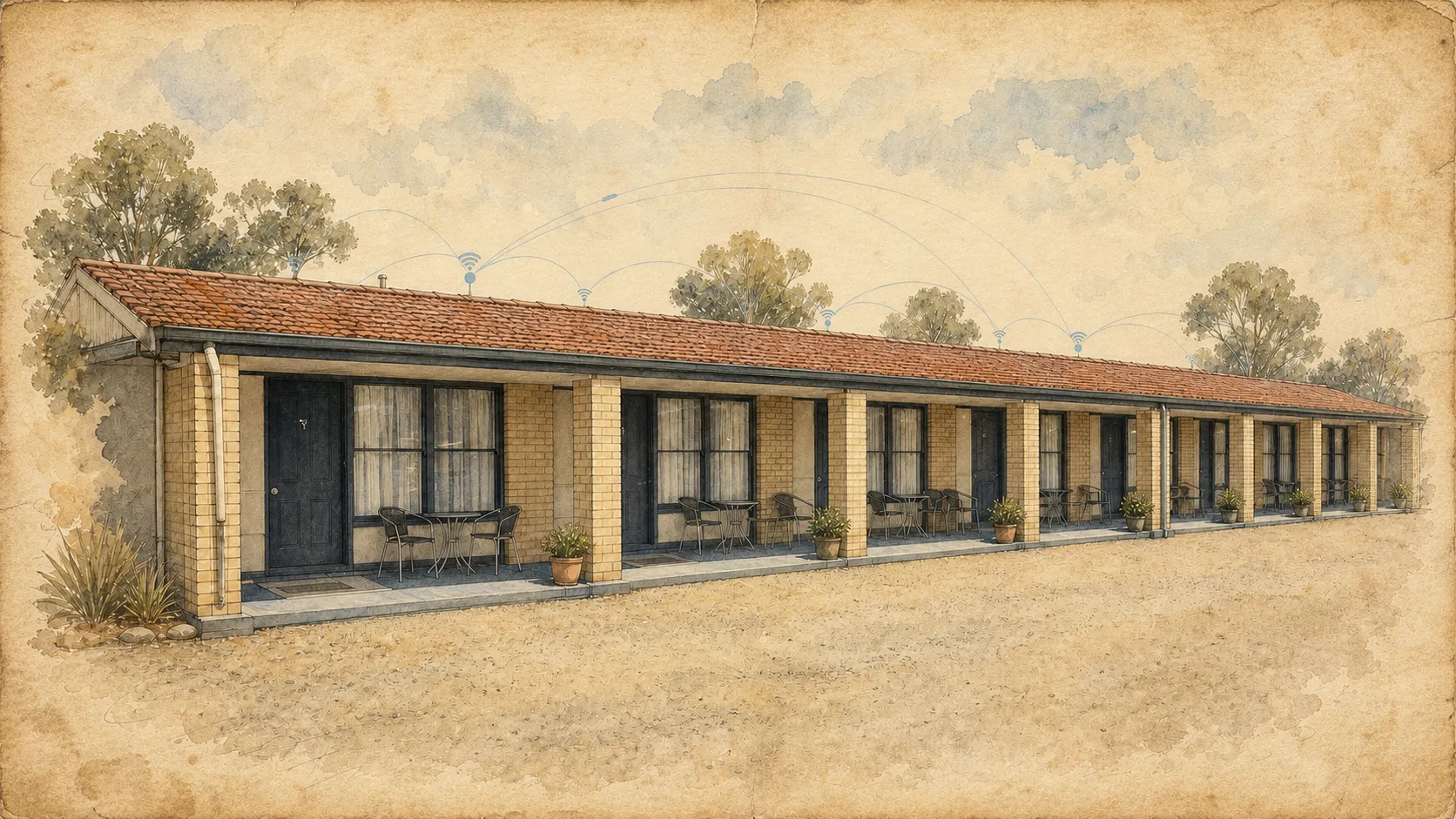
Point-to-point and point-to-multipoint Wi‑Fi backhaul carrying the network between buildings without trenching, industrial-rated networking equipment specified for the heat, indoor and outdoor access points placed for coverage across the whole grounds, and separate VLANs keeping guest access isolated from the motels' own systems.

05The Outcome

Each property now runs a single network that reaches its whole site — rooms, outdoor areas and back-of-house buildings alike — with guests on their own isolated access and equipment specified to keep working through the summers that used to end it. The next stage is already underway — IoT monitoring so the motels can see and manage their systems rather than hear about a problem from a guest.

Heat is the constraint people forget. Equipment rated for an air-conditioned comms room behaves differently in a roof space at the end of a Goldfields summer, and the failure is rarely dramatic — it is a slow drift into instability that reads as “the Wi‑Fi is bad” long before anything actually stops. Specifying for the temperature the site really reaches is cheaper than returning to it.

Existing cabling was less of a shortcut than it looks. Northam’s phone cabling could have carried a wired link, but it ran to the bedside tables where the phones were — not to anywhere a network wants to begin. Coolgardie had no phone cabling at all. That left new cable, and new cable between buildings means trenching across a property guests are staying on.

Linking the buildings over the air rather than through the ground changed what was affordable. Both point-to-point and point-to-multipoint links were used, each where the site suited it: Northam fans out to the rest of the property from a single vantage point at the office, while Coolgardie, built later when better equipment was available, runs separate direct links out to each building. Adding a building later is a mounting job rather than an excavation, and neither property lost a garden bed to a trench.

Neither property is meshed, and that is deliberate. A mesh would carry the traffic between buildings on the same radios serving the guests, so every hop spends bandwidth and adds delay — worst at the far end of the site, which is exactly where the coverage problem started. A dedicated link keeps the path between buildings separate from everything using it.

The two motels are separate businesses in different regions, and each got its own network — but they got it built to the same pattern, because the problem was the same shape at both. Guest separation was part of that pattern from the start: guests sit on their own network with no route into the motels’ own systems. That is also what makes the current work possible. Once a motel’s own systems are on a network of their own, monitoring them is an extension of the design rather than a new one.

Build something similar

If this sounds like your situation, tell us about your sites and systems. The brief arrives pre-loaded with this story so we start from context, not zero.